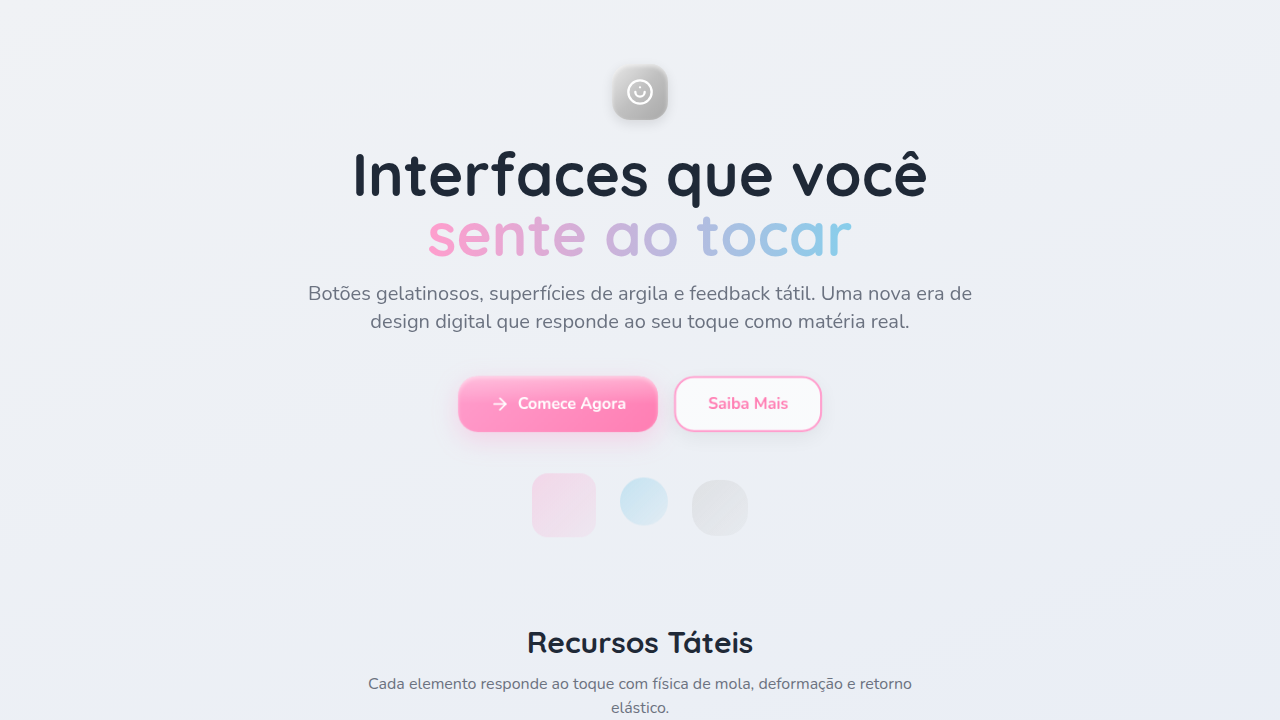
Tactile Digital / Deformable UI
Tactile deformable interface. Ideal for landing pages, saas. AI-ready template.
Use case: Landing pages, SaaS
Historical Context
Tactile Digital / Deformable UI style represents a modern trend in UI/UX web design focused on general.
Technical Specs
Colors
Primary
Effects
Press deformation (scale + squish), bounce-back (cubic-bezier), material response, haptic-like feedback, spring physics
Light/Dark
✓ Full / ✓ Full
CSS
transform: scale(0.95) on active, animation: bounce (cubic-bezier(0.34, 1.56, 0.64, 1)), box-shadow: inset for press, filter: brightness on press, spring physics (react-spring/framer-motion)
Variables
--press-scale: 0.95, --bounce-duration: 400ms, --spring-stiffness: 300, --spring-damping: 20, --material-glossy: linear-gradient(135deg, white 0%, transparent 60%), --depth-shadow: 0 10px 30px rgba(0,0,0,0.2)
Checklist
☐ Press effect visible, ☐ Bounce-back smooth, ☐ Material feels tactile, ☐ Spring physics tuned, ☐ Mobile touch responsive, ☐ Reduced motion option
DESIGN.md
Design System: Tactile Digital / Deformable UI
1. Visual Theme & Atmosphere
Tactile deformable interface. Ideal for landing pages, saas. AI-ready template. Tactile Digital / Deformable UI style represents a modern trend in UI/UX web design focused on general.
- Density: 5/10 — Balanced
- Variance: 4/10 — Moderate
- Motion: 4/10 — Subtle
2. Color Palette & Roles
- Chrome Silver (#C0C0C0) — Primary surface or dominant color
- Jelly Pink (#FF9ECD) — Primary text color
- Soft Blue (#87CEEB) — Accent highlight, links and focus states
3. Typography Rules
- Display / Hero: System UI stack (-apple-system, sans-serif) — Weight 700, tight tracking, used for headline impact
- Body: System UI stack (-apple-system, sans-serif) — Weight 400, 16px/1.6 line-height, max 72ch per line
- UI Labels / Captions: System UI stack (-apple-system, sans-serif) — 0.875rem, weight 500, slight letter-spacing
- Monospace: JetBrains Mono — Used for code, metadata, and technical values
Scale:
- Hero: clamp(2.5rem, 5vw, 4rem)
- H1: 2.25rem
- H2: 1.5rem
- Body: 1rem / 1.6
- Small: 0.875rem
4. Component Stylings
- Primary Button: Subtly rounded (0.5rem) shape. Accent color fill. Hover: 8% darken + subtle lift shadow. Active: -1px translate tactile press. Font weight 600. No outer glows.
- Secondary / Ghost Button: Outline variant. 1.5px border in muted color. Text in primary color. Hover: subtle background fill.
- Cards: Subtly rounded (0.5rem) corners. Surface background. Subtle shadow (0 2px 12px rgba(0,0,0,0.06)). 1px border stroke.
- Inputs: Label above input. 1px border stroke. Focus ring: 2px accent color offset 2px. Error text below in semantic red. No floating labels.
- Navigation: Primary surface background. Active item: accent color indicator. Font weight 500 when active.
- Skeletons: Shimmer animation matching component dimensions. No circular spinners.
- Empty States: Icon-based composition with descriptive text and action button.
5. Layout Principles
- Grid: CSS Grid primary. Max-width containment: 1280px centered with 1.5rem side padding.
- Spacing rhythm: Balanced. Base unit: 0.5rem (8px).
- Section vertical gaps: clamp(4rem, 8vw, 8rem).
- Hero layout: Split-screen (text left, visual right).
- Feature sections: Zig-zag alternating text+image rows. No 3-equal-columns.
- Mobile collapse: All multi-column layouts collapse below 768px. No horizontal overflow.
- z-index contract: base (0) / sticky-nav (100) / overlay (200) / modal (300) / toast (500).
6. Motion & Interaction
- Physics: Ease-out curves, 200-300ms duration. Smooth and predictable.
- Entry animations: Fade + translate-Y (16px → 0) over 420ms ease-out. Staggered cascades for lists: 80ms between items.
- Hover states: Subtle color shift + shadow adjustment over 200ms.
- Page transitions: Fade only (200ms).
- Performance: Only transform and opacity animated. No layout-triggering properties.
7. Anti-Patterns (Banned)
- No emojis in UI — use icon system only (Lucide, Heroicons)
- No pure black (#000000) — use off-black or charcoal variants
- No oversaturated accent colors (saturation cap: 80%)
- No 3-column equal-width feature layouts — use zig-zag or asymmetric grid
- No
h-screen— usemin-h-[100dvh] - No AI copywriting clichés: "Elevate", "Seamless", "Unleash", "Next-Gen"
- No broken external image links — use picsum.photos or inline SVG
- No generic lorem ipsum in demos
AI Prompt
Act as a Senior Frontend Engineer and Expert UI Designer. Your task is to code a complete Landing Page on the first attempt.
- Landing Page Theme:
- Sections to add:
Generate the final code immediately following these definitions:
Style
- Name: Tactile Digital / Deformable UI
- Type: Tactile, Deformable, Interactive, Playful
- Keywords: Jelly buttons, chrome, clay, squishy, deformable, bouncy, physical, tactile feedback, press response
- Era: 2025+ Tactile Era
- Light/Dark: ✓ Full / ✓ Full
Color Palette
- Primary: Gradient metallics, Chrome Silver #C0C0C0, Jelly Pink #FF9ECD, Soft Blue #87CEEB
- Secondary: Glossy highlights, shadow depth, reflection effects, material-specific colors
Visual Effects
Press deformation (scale + squish), bounce-back (cubic-bezier), material response, haptic-like feedback, spring physics
AI Visual Direction
Design a tactile deformable interface. Use: jelly/squishy buttons, press deformation effect, bounce-back animations, chrome/clay materials, spring physics, haptic-like feedback, material response, 3D depth on interaction.
CSS Technical
transform: scale(0.95) on active, animation: bounce (cubic-bezier(0.34, 1.56, 0.64, 1)), box-shadow: inset for press, filter: brightness on press, spring physics (react-spring/framer-motion)Design System Variables
--press-scale: 0.95, --bounce-duration: 400ms, --spring-stiffness: 300, --spring-damping: 20, --material-glossy: linear-gradient(135deg, white 0%, transparent 60%), --depth-shadow: 0 10px 30px rgba(0,0,0,0.2)Implementation Checklist
- ☐ Press effect visible
- ☐ Bounce-back smooth
- ☐ Material feels tactile
- ☐ Spring physics tuned
- ☐ Mobile touch responsive
- ☐ Reduced motion option
Execution Rules
- Strictly follow the defined visual style.
- Use high-quality inline SVG icons (Heroicons or Lucide style) — NEVER use emojis as icons.
- Add
cursor-pointerand smoothhoverstates (transition-all) on all interactive elements. - Required Page Structure:
- Navbar (Logo + Links + CTA)
- Hero Section (Impactful Headline + Subtitle + 2 buttons + 3D/Abstract visual element via CSS)
- Features (3 cards with icons)
- Testimonials (3 cards)
- Pricing (3 tiers, highlight the middle one)
- Final CTA
- Full Footer with social links, privacy policy, terms of use, contact and SEO links.
- All text content must be in English.
- The visual must be CLEARLY distinct — do not create a "default Bootstrap" design. Force the use of the provided design system variables.
- Use
<style>tags in the head for custom classes (especially for complex backdrop-filter effects and animations) that Tailwind CDN doesn't cover. - Full Responsiveness: Layout must adapt perfectly to Mobile, Tablet and Desktop (vertical stack on mobile).
- Include basic SEO, Viewport and Open Graph meta tags in
<head>. - Footer must contain: Copyright 2026, Secondary navigation links and Social media icons.
- Make the creative decisions needed to deliver the complete, functional result now.
Related
Last synced: 4/1/2026